Somewhat behind the times! Have been very lax - keep updating Twitter but blogless for more than a month! What's been up?
Well 28 May went and heard RC Newbury's Club Assembly - great bunch of people - also went to their 60th anniversary dinner in June (16th), complete with a founder member (someone who was there when they started in 1952!!).
29th May - Conference Committee for 2014 District Conference Inaugural meeting
30th May RC Elthorne Hillingdon President's Night at Northwood Golf Club.
2nd June - Club (RC Elthorne Hillingdon stall at Northwood & Northwood Hills Residents Associations Diamond Jubilee Fair - unprepossessing weather to start with but cheered up and we met lots of nice people and sold £500 of our Meal for Two tickets (for two local charities)
9th June - down to Upton-on-Severn to see Pepperpot Players in Joan Greening's (my clever wife!)The Continental Quilt - I was in the World Premiere in 1981!
11th June had to stand in as speaker at a combined clubs meeting in place of poorly Rotary in Britain & Ireland President Ray Burman - and no one threw anything - some even said they'd enjoyed it!
12th June - RC Sinodun Assembly - best turnout I've ever seen - more than 90% of membership
13th June - Off to Number 23 in my Be Better Known campaign - RC Faringdon
19th-20th June we were at The Compass Theatre, Ickenham for two charity performances of Madame Blavatsky Lives (written & directed by Joan Greening -2011) presented by RC Elthorne-Hillingdon - terrific audiences, brilliant cast and £3,500 raised for Kamuli Mission Hospital in Uganda.
23rd June at the Ickenham Festival Gala Day - great turnout - not much rain - super sales of Meal for Two and draw for the 22 lucky winners!!
Will try and keep up to date better!!
Friday, 22 June 2012

Wednesday, 23 May 2012
A message from UN Secretary-General Ban Ki-moon
I make no apology for quoting the full text of an article by UN Secretary-General Ban Ki-moon on how vital is for the world to complete the task of eradicating Polio. In it he praises the work of Rotary - help us to help free the world!
"Wipe Out Polio, Now -- By Ban Ki-moon
Wild viruses and wildfires have two things
in common. If neglected, they can spread out of control. If handled properly,
they can be stamped out for good. Today, the flame of polio is near extinction
— but sparks in three countries threaten to ignite a global blaze. Now is the
moment to act.
During the next two weeks, on two
continents, two events offer the chance for a breakthrough. First, the leaders
of the world’s largest economies — the G8 — congregate at the U.S. presidential
retreat at Camp David in rural Maryland. A week later, the world’s ministers of
health convene in Geneva. Together, they can push to deliver on an epic
promise: to liberate humankind from one of the world’s most deadly and
debilitating diseases.
The world’s war on polio, declared nearly a
quarter of a century ago, was as ambitious an undertaking as the successful
campaign to eradicate another great public health menace, smallpox. Slowly but
surely, over the years, we have advanced on that goal. Polio today survives in
only three countries: Afghanistan, Nigeria and Pakistan. That’s the good news.
The bad: we are in danger of falling victim to our own success.
Here’s why: the world is now populated by a
generation which has either never been exposed to polio or has been
inadequately vaccinated. When the virus strikes under those conditions, the impact
can be devastating. We saw that in the Republic of the Congo in 2010 and
elsewhere in Africa when an outbreak killed half of all who were infected. A prompt
emergency response by the international community halted that budding epidemic.
But the incident gives an idea of the potential consequences of failing to
eradicate polio while we have the chance. This year fewer than one hundred people
were left paralyzed by this easily preventable disease, almost all in the three
countries I have mentioned. Left unchecked, however, UN epidemiologists warn
that a renewed outbreak could cripple as many as one million people within the
decade, many of them children — the most vulnerable of the vulnerable.
This threat keeps me up at night because I
know how easy it is to address. My wife and I have personally immunized toddlers
in Asia and Africa, joining tens of millions of government workers, Rotarians,
volunteers, political and religious leaders (not to mention parents) who have
worked for decades to ensure that every child is protected. Most recently, we visited India, which just
two years ago was home to half of all the world’s children with polio. Now, thanks
to a concerted drive, we were able to celebrate India’s first polio-free year
in history.
Similar efforts are under way in the three
remaining polio-endemic countries. President Goodluck Jonathan of Nigeria,
Prime Minister Yousuf Gilani of Pakistan and President Hamid Karzai of
Afghanistan each personally oversee their national response. Nigeria has
committed funds from its own treasury, and polio eradication in all three
countries depends heavily on government resources. But that in itself is not
enough. With a determined push, the international community can wipe out polio
once and for all. To do so, however, it must organize — and commit the required
financial resources.
The United Nations, with its partner Rotary
International, is driving the global campaign. Our agencies are working hard to
reach all children, including those in refugee camps or swept up by natural disasters
and hunger emergencies. It may be difficult but it can be done. Somalia, to
name but one example, is afflicted by just about every human and natural
hardship known to humankind — but not polio. Its last case was in 2007, thanks in
no small part to local women who donned bright yellow smocks and traveled their
communities distributing vaccination drops.
The workers on the frontlines have no
shortage of dedication. But they do face a financial deficit. The Global Polio
Eradication Initiative has only half of the $2 billion it needs to procure
vaccines and deploy staff to the last bastions of the disease. Properly equipped, they can win this final
battle. If the international community recognizes the stakes and musters the
resources, we can win the war against polio — at long last and forever.
Now is the critical moment. If we invest $2
billion now — if we can cover a relatively modest $1 billion shortfall — we can
save the world an estimated $40-50
billion in the cost of treatment by 2035, not to mention many lives and many
young futures. When the world’s health ministers gather in Geneva later this
month, they will declare a global public health emergency and call on the world
to response to the threat of a resurgent polio. As the G8 leaders meet at Camp
David, they should be aware of what is coming — and recognize this great
opportunity to act in the name of the world’s people.
Those meetings will soon be followed by
others: the annual gathering of the G20 in Mexico, the Rio+20 conference in
Brazil and the European Union summit in Belgium. I hope polio will be on the agenda. I appeal to all leaders, everywhere, to act
now to protect future generations. By funding the Global Polio Emergency Action
Plan for the next two years, we can make the threat of
polio a distant and fading memory.
Ban Ki-moon is Secretary-General of the
United Nations.
Sunday, 13 May 2012
After the Convention
 After the intensity of the convention we needed to get
away for a few days to unwind – we needed a little oasis of calm and serenity,
not to mention somewhere to catch up on some much-needed sleep! We found it a two hour drive away (not driven
by us I hasten to add!) in Hua Hin, at the Centara Grand resort.
After the intensity of the convention we needed to get
away for a few days to unwind – we needed a little oasis of calm and serenity,
not to mention somewhere to catch up on some much-needed sleep! We found it a two hour drive away (not driven
by us I hasten to add!) in Hua Hin, at the Centara Grand resort. 
Originally built as the Railway Hotel in 1924
in a resort popularised by the King, the Centara Grand retains the colonial
feel (although Thailand has never been colonised, Britain has been a favourite example
since the days of King Rama V (famous as the King in The King & I)), lofty
and airy corridors, space, gardens (with exotic topiary!), pools and beach.
We ventured out occasionally for a little light shopping
& eating, including small elephant souvenirs and a couple of jackets
tailored in 48 hours, but other than that we just enjoyed the peace &
quiet.

Apart, of course, from our visit
to a Rotary Club! At the convention we
met some Rotarians from Hua Hin and discovered that there are two clubs in Hua
Hin, one older established & Thai-speaking and one, meeting in the next
door hotel, that is two years old & English-speaking and having their
Presidential Inauguration for the 2012-2013 Rotary year on the Saturday night
of our stay, the Rotary Club of Royal Hua Hin.
And so we spent the evening in the company of the mainly expatriate
members and their other halves, the incoming District Governor and his “Special
Representative” (no idea what that is), several Presidents of neighbouring
clubs and visiting Rotarians from Hawaii, Nepal and St Petersburg. Great fun and good to see a new club doing
great Rotary service with the local schools.
Convention Final Day
 On Day 1, there were tens of thousands of us in the main
Convention Hall. Probably set up to seat
25,000 people it was clear that barely a couple of thousand made it to the
first plenary session of the day. Anyone
one tells you this wasn’t achieved without self-sacrifice is being economical
with the truth. Up at 6:45 every day, on
the road by 8:00 – and this is supposed to be a holiday? Fortunately for those of us who did make the
effort, it was rewarding.
On Day 1, there were tens of thousands of us in the main
Convention Hall. Probably set up to seat
25,000 people it was clear that barely a couple of thousand made it to the
first plenary session of the day. Anyone
one tells you this wasn’t achieved without self-sacrifice is being economical
with the truth. Up at 6:45 every day, on
the road by 8:00 – and this is supposed to be a holiday? Fortunately for those of us who did make the
effort, it was rewarding.
Surprisingly, for those of us who have been less than
enthusiastic about Conference business sessions in the past, the elections and
voting held some interest. Interest from
two perspectives – the general and the personal. General from the viewpoint of
the number of clubs represented being around 11% of our worldwide chartered
clubs, just a little more than the 10% needed for a quorum – found this
interesting in the context of the recent RIBI conference where almost 40% of
clubs were represented and also in the response rates for both the RIBI
quinquennial review (just over 10%) and our own District Conference survey
(13%). Personal from the aspect that,
having participated in the official election of RI President-Nominee Ron
Burton, who will be RI Presidemt when I am District Governor, I then found
myself voting in the election of all the RI Officers for 2013-2014 – yes dear
readers, I voted for myself – now that’s a first!

President Nominee Ron gave a thoughtful speech with
passion for the things at the core of Rotary for the future, implementation of
the Strategy and support for The Rotary Foundation.
Wilf Wilkinson, past RI President and incoming chair of
the Rotary Foundation set out his key hopes for the coming Rotary year – his
ambition for Polio "interruption" in 2012-13 (I think he meant
significant progress in Pakistan, Afghanistan & Nigeria and no recurrence
in re-infected countries) – good planning for the introduction of Future
Vision, support for incoming RI President Sakuji Tanaka’s theme of Peace
Through Service, and increasing the sum raised through the Every Rotarian Every
Year programme (individual $100 donations) to $US 120 million)

John Hewko, RI’s General Secretary/CEO took us through
his vision of how the Secretariat will support the Strategy by:
a) making sure we get our due
share of the credit for the Eradication of Polio,
b) implementing the Strategic
Plan and making Future Vision a reality,
c) defining our Value Of
Service collectively – in financial terms, in man-hours to better show the
total contribution we make to society,
d) to make Membership more
appealing & relevant to younger people,
e) significantly improving our
Global Impact & Recognition
He said that Vision, Intelligent Planning & Hard Work are needed to meet the challenges of our second century but that he didn’t doubt that Rotarians had the collective tenacity to do so.

In a breakout session specifically for District Governors
for 2013-2104, RI President-Nominee Ron Burton & his wife Jetta talked to
the 100 or so of us.
He gave us his
views on what our priorities needed to be for our collective year:
a) Make
sure that the need for membership is institutionalised in our clubs-we should
each sponsor a new member during the
year personally and get each of our Presidents to do the same
b) Make
a personal contribution to Foundation, make the class of 2013-14 the first
class of District Governors to do so and get each of our President to do the
same
Our job is to inspire others! He also promised us several times “ You’re gonna lurrve the theme”.
Friday, 11 May 2012
Day 3 at the RI Convention 2012
Early on we took our regular trek out to IMPACT Muang
Thiong Thani without incident (which when you look at Bangkok’s traffic never
ceases to amaze me). Day 3 was
essentially Foundation day and following the report that we had indeed managed
to achieve a quorum of voting delegates for the proceedings on Day 4 (10% of clubs
present) it was over to out-going chair of The Rotary Foundation, Bill Boyd to
oversee proceedings.


Bill chose as his
theme “What a difference a day makes” and took us through a selection of days
during his visit to Foundation grant projects throughout the world. He talked about how a simple thing like the
availability of clean water can enable families to have the time to build
businesses using microcredit & have healthy lives, healthy children and
prosper more. He spoke also of the
importance of inclusivity – for a water project in Cameroon where Foundation
funds helped provide three water tanks for a village - for a variety of reasons
the tanks were 2.5 km from the village and the villagers were asked to
contribute their labour to dig a trench to pipe the water in - 4,000 of them
turned up – instantly local ownership was established!
 Amanda Martin is a
Rotary Peace Fellow alumna from Chulalongkorn University in Bangkok. She currently
works as Displaced Persons Public Health Curriculum development coordinator in
the Global Health Access Program at Community Partners International in
a refugee camp on the Thai/Burmese border. Amanda’s career focus is the
protection of human rights in developing countries. Prior to taking her
position with Community Partners International, she supported human rights in
Burma for ALTSEAN-Burma, a network of organizations and individuals based in
ASEAN member states working to support the movement for human rights and
democracy. She has also worked as director of the Guatemala Human Rights
Commission. While I’m sure that her
heart is in the right place I did have to wonder at the wisdom of some of the
things she told us of. I’m not sure that
telling refugees in the camp that they don’t get the basic rights of refugees
because Thailand hasn’t signed up to the 1951 treaty on refugees is entirely
likely to maintain peace!
Amanda Martin is a
Rotary Peace Fellow alumna from Chulalongkorn University in Bangkok. She currently
works as Displaced Persons Public Health Curriculum development coordinator in
the Global Health Access Program at Community Partners International in
a refugee camp on the Thai/Burmese border. Amanda’s career focus is the
protection of human rights in developing countries. Prior to taking her
position with Community Partners International, she supported human rights in
Burma for ALTSEAN-Burma, a network of organizations and individuals based in
ASEAN member states working to support the movement for human rights and
democracy. She has also worked as director of the Guatemala Human Rights
Commission. While I’m sure that her
heart is in the right place I did have to wonder at the wisdom of some of the
things she told us of. I’m not sure that
telling refugees in the camp that they don’t get the basic rights of refugees
because Thailand hasn’t signed up to the 1951 treaty on refugees is entirely
likely to maintain peace! 
Major Polio Plus donor Rajashree Birla
spoke next. Mrs Birla serves as a
director on the boards of all of the businesses that make up the Aditya Birla
Group (ABG), a Fortune 500 company that is one of Asia’s most diversified conglomerates. ABG
produces aluminum, carbon black, cement, clothing, copper, palm oil, and other goods. Subsidiaries include a
mobile phone company, an insurance firm, and a chain of supermarkets. In 1995, the Birla family established
the Aditya Birla Foundation in memory of Birla’s husband, Aditya, one of India’s
foremost industrialists and an active philanthropist. She is an honorary member
of the Rotary Club of Bombay and received that club’s Citizen of Bombay Award
in 2003. She is also an honorary member of the Rotary Club of Mulund, which recognized
her with the Pride of India Award in 2004. The Birla family strongly supports
the End Polio Now campaign and has generously contributed $US5.2 million to
Rotary’s US$200 Million Challenge, including a donation of $US1 million at the
Convention.
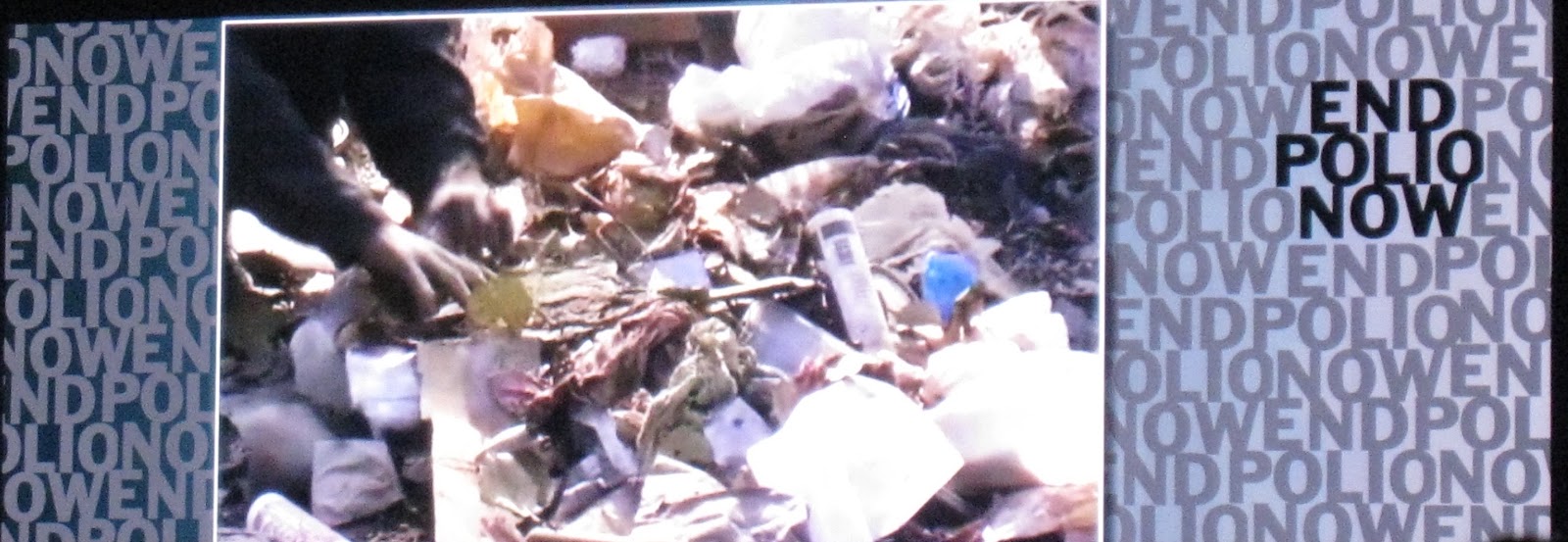 Undoubted the highlight of the
morning, and probably of the whole Convention was Bruce Aylward from WHO. Bruce addressed Convention in Montreal two
years ago. Equally outstanding then he said “you have Polio on the
run" and "Rotary's decision in 1985 challenged the world to change
the course of history by eradicating this crippling disease. Rotary is the heart
& soul of the largest global health effort in history". Today he told us that “we now have the lowest
number of polio infected countries, the lowest number of polio cases in
history”. He went on “A polio free India,
which was said to be impossible, is a magnificent achievement - it is Rotary's
achievement. When India was declared polio-free, India's Prime Minister said
thank you, not to WHO, not to UNICEF, not to US CDC but thanks to Rotary”. He declared “there are now no technological
barriers to eradication, only political & social barriers and these are the
areas where Rotary can excel”. Type 2 polio
is now history, Type 3 is now limited to only two countries in the past 10
months. But the need for action to
complete the task is now critical, is now an emergency - recent cases have highlighted
the pressing need. In recent times it is
adults now being infected and 50% died in last year’s outbreak in
Tajikistan. “We must be faster - more
focused - faster in finding the missed children and why they were missed”.
Undoubted the highlight of the
morning, and probably of the whole Convention was Bruce Aylward from WHO. Bruce addressed Convention in Montreal two
years ago. Equally outstanding then he said “you have Polio on the
run" and "Rotary's decision in 1985 challenged the world to change
the course of history by eradicating this crippling disease. Rotary is the heart
& soul of the largest global health effort in history". Today he told us that “we now have the lowest
number of polio infected countries, the lowest number of polio cases in
history”. He went on “A polio free India,
which was said to be impossible, is a magnificent achievement - it is Rotary's
achievement. When India was declared polio-free, India's Prime Minister said
thank you, not to WHO, not to UNICEF, not to US CDC but thanks to Rotary”. He declared “there are now no technological
barriers to eradication, only political & social barriers and these are the
areas where Rotary can excel”. Type 2 polio
is now history, Type 3 is now limited to only two countries in the past 10
months. But the need for action to
complete the task is now critical, is now an emergency - recent cases have highlighted
the pressing need. In recent times it is
adults now being infected and 50% died in last year’s outbreak in
Tajikistan. “We must be faster - more
focused - faster in finding the missed children and why they were missed”.
Stirring stuff!

We then had Bill Gates
on pre-recorded video, reminding us that the additional US$50million given in
January was to encourage further fundraising – we aren’t done yet! Echoing Bruce Aylward’s words he said “Raise
your voices even louder to mobilise others to be as committed to end Polio as
you are”. He urged us to galvanise our
politicians to take the steps needed, to declare an emergency at the upcoming
World Health Summit and to support it with funds.
 Finally, to round the morning off,
John Germ, Rotary’s US$200 Million Challenge Committee Chair gave us an update
on what the Challenge has raised to date – more than $US215 million and still 6
weeks to go. He said “There are people
in the room who haven't been vaccinated against Smallpox because they were born
after it was eradicated. Let's get to the same point with Polio”. He noted that Rotary has raised (with Gates)
US $2 billion US towards eradication, but we have to keep going, we’re not done
yet.
Finally, to round the morning off,
John Germ, Rotary’s US$200 Million Challenge Committee Chair gave us an update
on what the Challenge has raised to date – more than $US215 million and still 6
weeks to go. He said “There are people
in the room who haven't been vaccinated against Smallpox because they were born
after it was eradicated. Let's get to the same point with Polio”. He noted that Rotary has raised (with Gates)
US $2 billion US towards eradication, but we have to keep going, we’re not done
yet.
In the afternoon we attended a breakout session on Best
Practices for Membership Growth.
Including RIBI President Ray on the panel, the session reminded us of
some fairly basic things that we need to keep doing and some useful pointers to
work on, including some very useful stuff on generating a new club of younger
professionals.
Another tedious journey back to our hotel took us over
two hours from the end of the breakout session to our arrival.
However the evening was outstanding – I mean
you can’t come to Bangkok and not go to the Calypso Cabaret (the LadyBoys of
Bangkok). Judge for yourself from the
pictures!!


Second Day at the Rotary International Convention in Bangkok
For anyone who hasn’t been to a Rotary International
Convention, the first day (Sunday) is where we get the formalities over and
check out the House of Friendship – it’s Day 2 when we get into the real stuff. So we made our daily trek out to the
Convention Centre in good time.

Our
first speaker was Hugh Evans, founder of the Global Poverty Project, who looks
frighteningly young for one who has achieved so much. His social
entrepreneurial spirit was brought to life during a stay in the Philippines
when he was 14. He lived with his host family in a tent in a Manila slum built
on a garbage dump. This experience, as
well as the year he spent in India when he was 15, enabled him to see
opportunities to help improve the lives of the world’s poor. In 2002, he
established the Oaktree Foundation, Australia’s first youth-run aid
organization, dedicated to bringing young people together to help end global
poverty. Since 2003, development projects funded by Oaktree have been
established in the Philippines, Papua New Guinea, India, Ghana, and
Timor-Leste, providing educational opportunities to more than 40,000 young
people. His next endeavour was the Make Poverty History campaign, which
included illuminating the sails of the Sydney Opera House for several days with
faces of poverty, and a globally broadcast concert featuring U2’s Bono. A captivating speaker and big fan of Rotary - "A conviction that 1.2 million people can work together to change the world - that's Rotary",
Hugh provided a terrific start to the day.
He was followed by
Benin-born, Angelique Kidjo, a Grammy Award- winning singer-songwriter
and activist who was named a UNICEF Goodwill Ambassador in 2002. In addition to
her work with UNICEF she has partnered with groups including Oxfam, the
International Federation of Human Rights, and Amnesty International, in
campaigns promoting peace, clean water, AIDS/HIV awareness, and human rights. In
2006, she founded the Batonga Foundation, which gives girls access to secondary
school and higher education so they may take lead roles in changing
Africa. Angelique had us singing along
to one of her compositions.

Indian motivational speaker Shiv Khera
followed. Based in the US, he runs
motivational & leadership courses.
Of the many homilies & bon mots he treated us to, (each repeated
slowly several times!) my favourite was “Confidence without humility
equals arrogance” – how often have we seen that?

Nobel Prize-winner Dr
Mohammed Yunus, universally known as the father of microcredit through the
Grameen bank in Bangladesh was next. In
1976, during visits to very poor households in Jobra, a village near Dhaka
University, Yunus discovered that very small loans could make an enormous
difference. Bamboo furniture is made by women in the village of Jobra. To
obtain bamboo to produce furniture, women were forced to take loans at usurious
rates from moneylenders. The majority, if not all, of the profits derived from
their efforts were owed to pay back the loans provided by the moneylenders.
Shocked by this reality, he lent the equivalent of US$27 from his own pocket to
42 people in the village to help them pay back their loans. As of May 2009,
Grameen Bank had 7.5 million borrowers, 97 percent of whom are women. With
2,554 branches, the bank provides services in 84,237 villages, more than 97
percent of all villages in Bangladesh, and had lent over $7 billion to poor
people, with nearly 100 percent repayment rate.
Dr Yunus also spoke of his ideas of social business, where small
businesses are encouraged in partnership with a more affluent entrepreneur – have to say that this idea didn’t resonate
with me – mind you I might have thought the same about microcredit when it was
first launched, so what do I know?
All this was in the morning
session! In the afternoon we went to a
breakout on social media. Despite being
a user of Facebook & Twitter I feel I need to know more about how these and
other social media developments can help Rotary relate better to the world of
the younger people we would like to attract as members. The session did not disappoint.
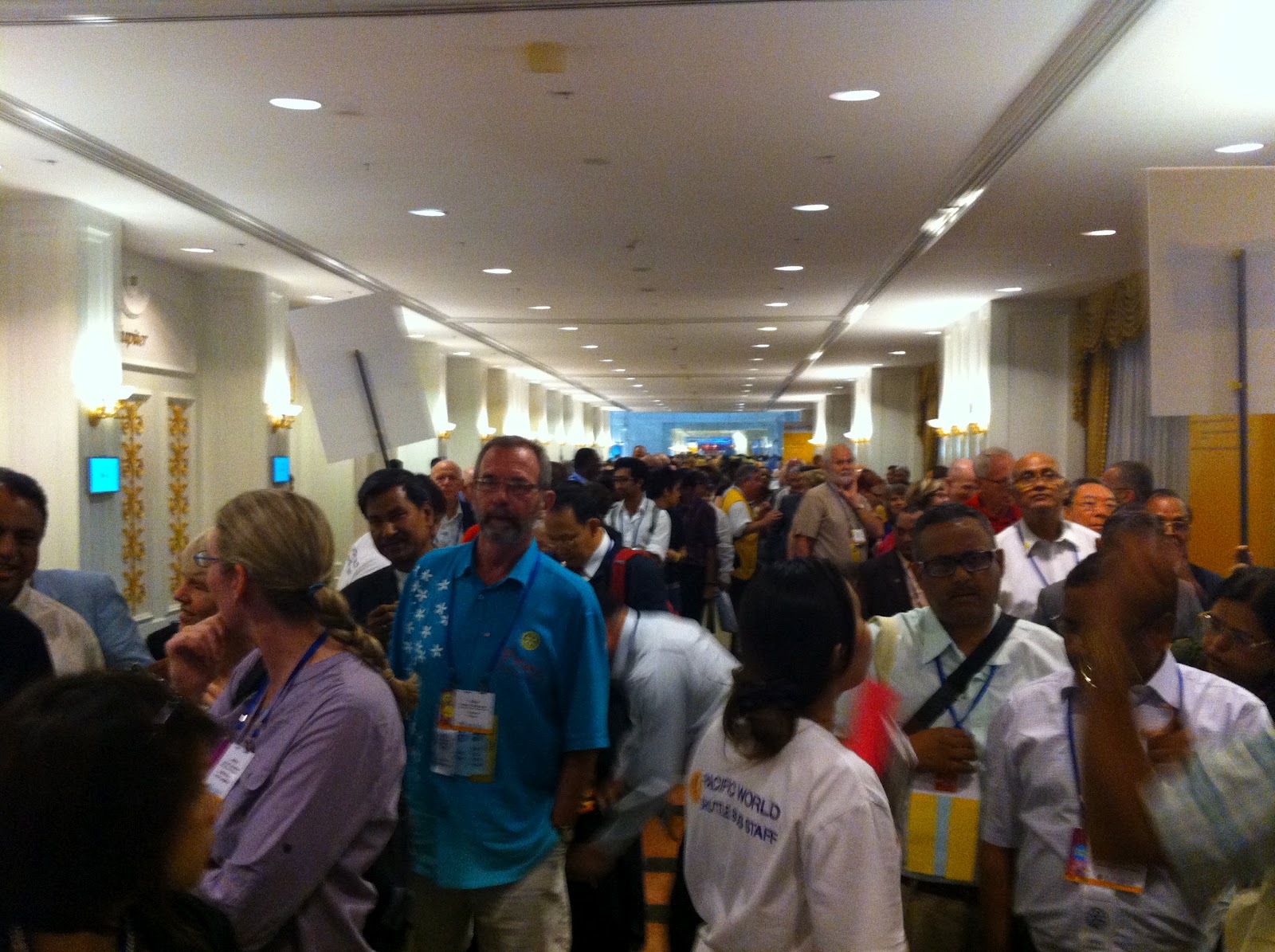 To date the journeys hadn’t been too bad. However, this turned out to be the
exception. For reasons best known to
themselves the organisers, having finished the afternoon sessions at 4p.m,
elected to not have the coaches going back to the hotels until 6 p.m.
To date the journeys hadn’t been too bad. However, this turned out to be the
exception. For reasons best known to
themselves the organisers, having finished the afternoon sessions at 4p.m,
elected to not have the coaches going back to the hotels until 6 p.m.
It’s reasonable to say that chaos ensued in
the queues for the shuttles going to the coaches that were going to the
Skytrain terminus!
Big treat of the evening was drinks at
Lebua. A bar on the 64th
floor of State Tower, it has outside seating with magnificent views of the city
of Bangkok, home to 12 million people (roughly the same size as London).

Inevitably we found ourselves with fellow
Rotarians, from Germany, Solingen to be precise, the steel capital of the
area. We were presented with a most
impressive knife (not to be paced in hand luggage! Dinner at Mesamis café at
Grand Central hotel across from the Marriott rounded off the day nicely.
Subscribe to:
Posts (Atom)